

FND Connect · Online learning
FND workplace adjustments
Developed and delivered by FND Connect CIC, a UK-based nonprofit organization supporting people affected by Functional Neurological Disorder (FND).
Our courses provide structured professional development and practical FND awareness training for educators, healthcare support staff, employers and other professionals.
Participants who successfully complete the training receive an FND Connect Certificate of Completion, confirming the course content and learning hours.
Accreditation notice: These courses are independently developed and certified by FND Connect. They do not currently award accredited US Continuing Education Units (CEUs), Continuing Medical Education (CME) credits or state-approved professional license renewal credits. Acceptance for professional development purposes is at the discretion of individual employers, institutions and licensing authorities.
Workplace adjustments managers and HR can agree in writing.
8 modules · printable workbook · completion certificate
$100.00 per person · one-off payment
FND workplace adjustments for employers, line managers, HR teams and colleagues. The course covers workplace adjustments and reasonable accommodations: symptom barriers, a calm episode plan and a return to work the team can sustain. People with FND who need rights, sick leave and state vocational rehabilitation guidance should use the free FND and work guide. This course is for the people employing or working alongside them. It does not train staff to provide personal care.
- Recognize barriers caused by symptoms and agree useful changes with the employee.
- Plan a calm response to episodes, with clear roles and individual safety guidance.
- Review adjustments, absence and return-to-work plans through supportive conversations.
Choose with confidence
Employment, HR and line management
For: Employers, managers, HR teams and colleagues
Agree workplace adjustments through supportive conversations with the employee.
Use the learning in your setting
Work through workplace adjustments and reasonable accommodations, episode planning, absence and return-to-work conversations, then use the workbook to record and review what was agreed.
Training staff to deliver care is different from supporting an employee at work. Care providers should choose social services; clinicians should choose healthcare training.
For employers, HR and line managers
Course: Foundation Certificate in FND Awareness & Support at Work
Workplace adjustments and reasonable accommodations for colleagues with FND. This is manager and HR training, not a course in providing personal care.
Workplace awareness: For line managers, HR teams, employers and colleagues who need workplace adjustments for someone with FND. No prior FND knowledge is required. It covers reasonable accommodations, episode plans and return to work. It is not clinical or occupational-health certification, and it is not the rights guide for employees.
Supporting a relative or friend outside a paid care role? Caring for someone with FND is free after a reviewed access request.
What your $100.00 includes
Practical support for the working day: symptom-specific actions, safe episode response, adjustments that operate in practice, fair conversations and sustainable returns.
- Eight expanded lessons with symptom-specific support and setting-specific examples
- Eight guided planning activities with worked responses
- Module knowledge checks, an 80% pass mark and unlimited retakes
- A printable practice workbook with support-plan, adjustment and review prompts
- A numbered Certificate of Completion with an online verification record
Symptom-specific support: weakness and falls; tremor, jerks and spasms; speech and voice; brain fog; fatigue and pain; dizziness and sensory overload; visual and sensory changes; swallowing difficulties; and functional seizures.
Allow around 6 hours for reading, reflection and the suggested activities, plus assessment time. Those hours are the learning hours on the certificate. They are not CEU, CME, or state license credits. Assessment time is not added. Pause and return whenever you need.
Developed and delivered by FND Connect CIC, a UK-based nonprofit organization supporting people affected by Functional Neurological Disorder (FND).
Our courses provide structured professional development and practical FND awareness training for educators, healthcare support staff, employers and other professionals.
Participants who successfully complete the training receive an FND Connect Certificate of Completion, confirming the course content and learning hours.
Accreditation notice: These courses are independently developed and certified by FND Connect. They do not currently award accredited US Continuing Education Units (CEUs), Continuing Medical Education (CME) credits or state-approved professional license renewal credits. Acceptance for professional development purposes is at the discretion of individual employers, institutions and licensing authorities.
The workbook is available after enrollment. The online practical portfolio requires saved decisions and revised outputs. Structured decisions are checked automatically; written explanations are not independently marked. Healthcare courses also require the final-case rubric. This course supports everyday inclusion and does not replace first-aid training, clinical advice or individual legal advice.
Try a scenario from the course
Several symptoms at once
During a busy reception shift, Priya's familiar hand tremor increases, her speech becomes effortful and she loses track of callers. She indicates that she needs the agreed pause. There are no new emergency signs.
Think it through: What should the colleague do in the next minute?
Read the worked response
Arrange reception cover, reduce competing conversations and ask whether typing or a simple yes/no question is easiest. Offer the agreed accessible rest space when Priya can move safely. Do not require a spoken explanation in front of customers. Later, review interruptions, standing time and whether cover actually arrives when requested. Record functional barriers and agreed changes, not an assumption that Priya cannot do reception work.
Each of the 8 modules includes a practical activity with a worked response.
FND workplace adjustments: course modules
What FND Is - and Isn't
The science, scale and reality of Functional Neurological Disorder
Learning outcomes and activity
- Explain in plain terms what FND is and how common it is
- Describe why FND symptoms are genuine and involuntary
- Outline what is known about why FND develops and how it is treated
- Recognize and challenge common myths about FND
- Separate supportive management from diagnosis and treatment
Practice: The first disclosure
How FND Shows Up at Work
Symptoms, fluctuation and the invisible nature of FND
Learning outcomes and activity
- List the main ways FND symptoms present
- Recognize how symptoms may look in ordinary workplace situations
- Understand why ability can change day to day
- Know when to follow the usual plan and when to seek urgent help
- Choose immediate and ongoing support for eight symptom groups
Practice: Several symptoms at once
Functional Seizures & Episode First Aid
Responding safely and with dignity when symptoms escalate
Learning outcomes and activity
- Describe what functional seizures and dissociative episodes can look like
- Respond to an episode step by step, including what never to do
- Know when to call 911 rather than follow the usual plan
- Support recovery, dignity and the rest of the team after an episode
- Rehearse an episode response including airway, escalation and recovery
Practice: The regular first aider is absent
Legal Responsibilities & Support at Work
Americans with Disabilities Act, reasonable accommodations and support
Learning outcomes and activity
- Understand when FND counts as a disability in law
- Explain the duty to make reasonable accommodations
- Know the main support routes, including state vocational rehabilitation
- Turn an adjustment request into an accountable decision
Practice: A request that has stalled
reasonable accommodations That Work
Practical changes that help - and what doesn't
Learning outcomes and activity
- Identify practical adjustments for FND
- Understand pacing and energy management
- Recognize unhelpful responses to avoid
- Write measurable adjustment trials and task-specific safety controls
Practice: A break that cannot happen
Absence, Return to Work & Fair Careers
Managing time off, phased returns, performance and progression
Learning outcomes and activity
- Manage FND-related absence fairly and keep in touch well
- Plan a phased return that actually holds
- Handle performance concerns fairly where FND may be a factor
- Keep development and progression open to employees with FND
- Plan a phased return with workload, recovery and review built in
Practice: A return that looks successful on paper
Talking About It & Building Culture
Conversations, confidentiality and inclusion
Learning outcomes and activity
- Hold a supportive disclosure conversation
- Balance team awareness with confidentiality
- Model an inclusive culture as a manager
- Handle disbelief and share practical support without exposing private history
Practice: The team chat
Putting It Into Practice
Support plans, scenarios and next steps
Learning outcomes and activity
- Build a simple workplace support plan
- Apply learning to realistic scenarios
- Know where to get further help
- Produce and test a complete workplace support plan
Practice: A complete plan under pressure
How it works
Enroll
Pay once with your name and email. You'll get a private link to your course — no account or password needed.
Learn & test
Work through 8 modules at your own pace and pass a short test at the end of each (retake as often as you need).
Receive your certificate
Pass every module and download your Certificate of Completion — uniquely numbered and publicly verifiable.
A record of what you have completed
Pass every module at 80% to earn your Foundation Certificate in FND Awareness & Support at Work. You must also answer every safety-critical question correctly. Retakes use a fresh selection after you review your feedback. You must also complete the practical portfolio, including the final case on healthcare courses.
Download a named Certificate of Completion with your completion date, a unique certificate number and a public verification link. Retakes are unlimited and included in your course price.
Issued by FND CONNECT CIC. This is not a regulated qualification.
Developed and delivered by FND Connect CIC, a UK-based nonprofit organization supporting people affected by Functional Neurological Disorder (FND).
Our courses provide structured professional development and practical FND awareness training for educators, healthcare support staff, employers and other professionals.
Participants who successfully complete the training receive an FND Connect Certificate of Completion, confirming the course content and learning hours.
Accreditation notice: These courses are independently developed and certified by FND Connect. They do not currently award accredited US Continuing Education Units (CEUs), Continuing Medical Education (CME) credits or state-approved professional license renewal credits. Acceptance for professional development purposes is at the discretion of individual employers, institutions and licensing authorities.
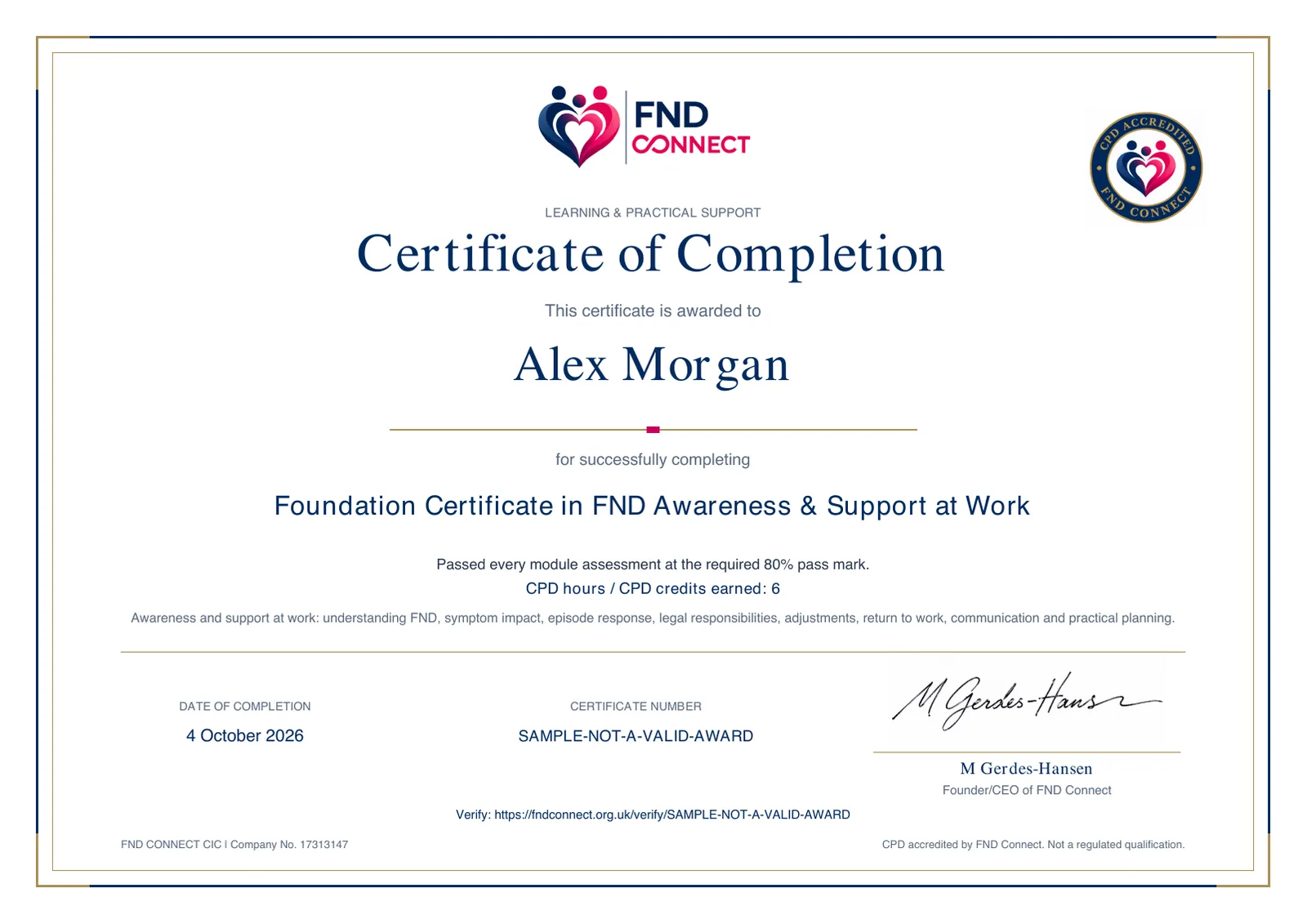
Using the workplace course in your development record
FND Connect Certificate of Completion. FND CONNECT CIC has reviewed this course against the FND Connect FND Connect course standards and verified that it meets the conditions for accreditation. The certificate shows the guided learning hours on this page as guided learning hours, at one guided learning hour per hour of study. It does not replace occupational health advice or legal advice, and it is not a regulated qualification. Your employer decides whether to accept the hours.
Record the time you actually spend learning, reflect on a workplace scenario and identify one adjustment or management practice to discuss with your team.
Developed and delivered by FND Connect CIC, a UK-based nonprofit organization supporting people affected by Functional Neurological Disorder (FND).
Our courses provide structured professional development and practical FND awareness training for educators, healthcare support staff, employers and other professionals.
Participants who successfully complete the training receive an FND Connect Certificate of Completion, confirming the course content and learning hours.
Accreditation notice: These courses are independently developed and certified by FND Connect. They do not currently award accredited US Continuing Education Units (CEUs), Continuing Medical Education (CME) credits or state-approved professional license renewal credits. Acceptance for professional development purposes is at the discretion of individual employers, institutions and licensing authorities.
Frequently asked questions
Who is the FND workplace adjustments course for?
For line managers, HR teams, employers and colleagues who need workplace adjustments for someone with FND. No prior FND knowledge is required. It covers reasonable accommodations, episode plans and return to work. It is not clinical or occupational-health certification, and it is not the rights guide for employees.
What is included in the $100.00 course price?
8 online modules, a test for each module, unlimited retakes and a downloadable Certificate of Completion after passing every module and completing the practical portfolio. A printable workplace planning workbook with eight scenario activities, worked responses, symptom-support prompts, an episode-response planning template and an adjustment-plan template. This is a one-off payment per person, not a subscription.
How long does the course take?
Allow around 6 hours for reading, reflection and the suggested activities, plus assessment time. Those 6 hours are the guided learning hours on the certificate. Assessment time is not added. Study at your own pace and return using your private access link.
Is this accredited FND CPD workplace training?
Yes. This is FND Connect Certificate of Completion. Self-accredited course. FND CONNECT CIC is the training provider. It has reviewed this course against the FND Connect FND Connect course standards and verified that it meets the conditions for accreditation. The certificate shows 6 guided learning hours, counted as 6 guided learning hours. This is not a regulated qualification, and it is not endorsement by a statutory regulator. Your employer or professional body decides whether to accept the hours.
How do I earn the certificate?
Pass each module assessment with at least 80%. Every safety-critical question must also be answered correctly. After an unsuccessful attempt, review the feedback and lesson before starting a fresh selection of questions. Complete the staged practical portfolio as well; healthcare courses include a final case with six automatically checked criteria. Written reflections are saved but not independently marked. You can retake tests as often as you need. Your downloadable Certificate of Completion shows your name, the course, completion date, guided learning hours, guided learning hours and a unique certificate number with a public verification link. It is issued by FND CONNECT CIC. It is certified by FND Connect by FND Connect and it is not a regulated qualification.
Is this live training or a video course?
It is self-paced learning through written modules, diagrams, practical scenarios and short tests. The printable workbook supports the required online practical portfolio. Structured decisions are checked automatically; written explanations are saved but not independently marked. There are no scheduled live sessions.
What happens after payment?
After successful payment, you can access your course through a private link, which is also emailed to you. You do not need to create an account or password. Use your own name and email so your access and certificate are correctly assigned.
How does this course differ from the other FND courses?
Training staff to deliver care is different from supporting an employee at work. Care providers should choose social services; clinicians should choose healthcare training.
Can staff use the free family caregivers course instead?
No. Free family-caregiver access is reserved for unpaid personal caring and requires manual approval. Paid care work, care networks and organizational training need a paid course for the relevant setting. Each learner receives their own access and completion record.
What workplace adjustments help with FND?
Workplace adjustments are practical changes agreed with the employee, such as pacing, a lower meeting load, a quiet recovery space, flexible hours or a clear episode plan. The workbook helps managers and HR record and review them. The course does not decide what the Americans with Disabilities Act requires in an individual case.
What reasonable accommodations should managers consider?
Reasonable accommodations are the workplace changes a manager and the employee agree so the job is doable, such as how meetings run, where someone recovers, how hours flex and how the team responds to an episode. This course helps you write that down and review it. It does not give a legal ruling. Employees who need rights and state vocational rehabilitation guidance should use the free FND and work guide.
Is this course for employees who have FND?
It is written for employers, managers, HR and colleagues. Employees looking for rights, state vocational rehabilitation and sick-leave guidance should use the free FND and work guide. Care workers who deliver personal care need the care workers course.
Enroll in FND workplace adjustments
$100.00 per person, paid once. Includes all 8 modules, workbook, tests, retakes and your certificate after passing the assessments and completing the practical portfolio.